The trench roller vs. plate compactor question comes up on almost every job that involves moving soil, laying pipe, or prepping a base course. Both machines compact material by transferring vibration into the ground, but they are built for different soil types, different trench widths, and different stages of a project. Picking the wrong one costs a contractor time, fuel, and sometimes a failed compaction test. Picking the right one keeps a crew moving and keeps an inspector satisfied on the first pass.
At ETS Equipment Rental, we stock a full compaction lineup out of our Hopedale and North Andover, MA locations, so a general contractor can match the machine to the soil rather than force one piece of equipment to handle every task. Here is how the trench roller compares to the plate compactors, rammers, and rollers in our fleet, and where each one belongs on a project timeline.
1. Know the soil before you pick the machine
Cohesive soils like clay and silt behave differently under vibration than granular soils like sand and crushed stone. Clay needs a kneading, high-impact action to push out air pockets and achieve density. Sand and gravel respond better to straight vibratory force spread across a flat plate. That distinction is the starting point for every trench roller vs. plate compactor decision, and it is the reason ETS carries more than one type of compaction equipment rather than a single all-purpose unit.
2. Trench Roller: Built for cohesive soils in confined trenches
The Trench Roller 1.5 Ton in our compaction category is a 2025 Husqvarna LP 9505, and it is purpose-built for the situation a plate compactor struggles with: deep, narrow trenches filled with clay or silt backfill around utility lines. It runs on a Kubota D1105 diesel engine rated at 24.3 hp, producing up to 16,186 lbf of centrifugal force through articulated, high-traction padfoot drums that knead cohesive material instead of just pressing on top of it.
Two details make this trench roller especially practical for utility and site work. First, the padfoot drums are designed to walk themselves down into a trench and compact backfill in lifts, which matters when a pipe or conduit sits below grade and needs even support along its full length. Second, the unit runs on radio remote control, so an operator can stand at trench level and guide it without climbing in beside an open excavation. On projects governed by OSHA trenching rules, keeping personnel out of the trench while the machine works is a real safety advantage, not a minor convenience.
Typical applications for this trench roller include utility trench backfill, foundation sub-base preparation, and compacting clay or silt beneath roadways and parking lots. If a compaction test keeps failing on cohesive fill, a trench roller is usually the fix.
3. Plate Compactors: The right call for granular base and open areas
For sand, gravel, and other granular materials, a plate compactor is the more efficient choice, and ETS rents two versions depending on the scope of the job. The Dynapac DFP9X is a forward-travel vibratory plate powered by a Honda GX160 engine, generating around 4,271 lbf of compaction force in a compact 210-lb frame. It suits smaller areas, asphalt patch repairs, and tight spaces where maneuverability matters more than raw output.
The Reversible Plate Compactor, built around a Honda GX200 engine, moves forward and backward under power, which lets an operator compact a wider footprint without repositioning the machine constantly. At 529 lbs with a working speed up to 82 feet per minute, it handles paver base, driveway prep, and trench backfill on medium-duty jobs where the fill is granular rather than clay-heavy.
4. Jumping Jack
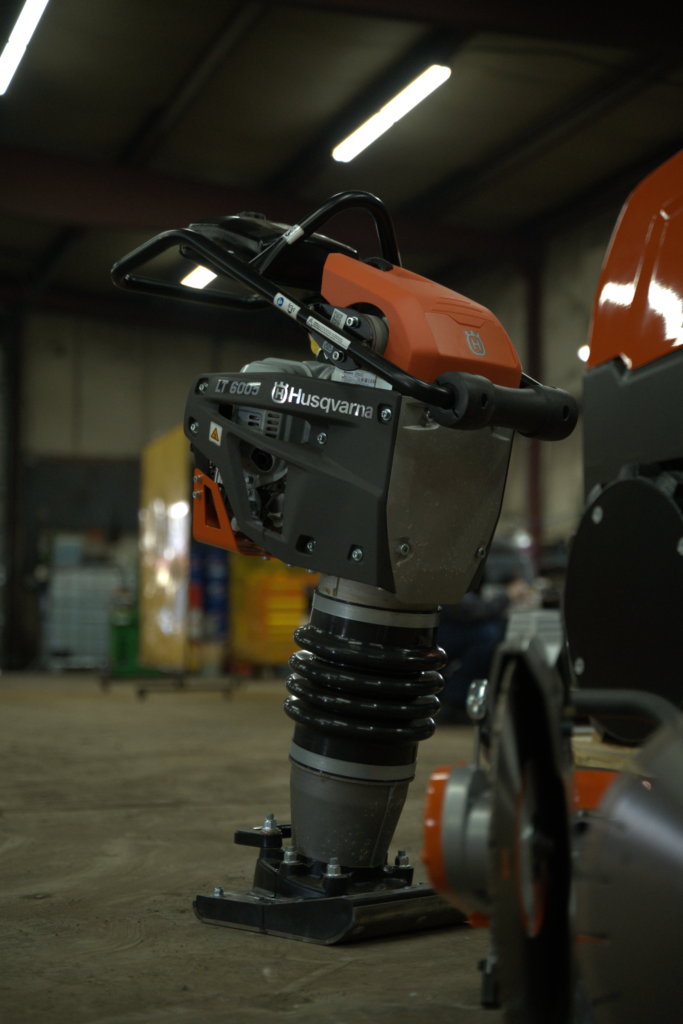
Some trenches are too tight for a trench roller or a plate compactor to fit at all. That is where the Jumping Jack 150 lbs earns its place in the fleet. Built around a Husqvarna LT 6005 rammer with a Honda GXR120 engine, it delivers roughly 2,950 lbf of impact force through a 9-inch or 11-inch shoe, which is exactly the footprint needed for utility lines, footings, and pipe trenches in confined spaces. Where a trench roller compacts wide backfill lifts efficiently, a jumping jack takes over in the narrow sections a roller physically cannot reach.
5. Compact Roller: Finishing driveways, lots, and asphalt
Once backfill and base work are done, some projects call for a finished, drum-rolled surface, and that is the Compact Roller’s job. This ride-on tandem drum unit runs on a Kubota D722 diesel engine, weighs around 3,100 lbs, and travels up to 5 mph with 35% gradeability, making it well suited to asphalt and soil compaction on driveways and small parking lots after the trench roller and plate compactors have finished the heavier groundwork.
Matching equipment to project phase
Many jobs move through three or four of these phases in sequence, which is why keeping a trench roller and a plate compactor both on standby, rather than committing to just one, tends to save more time than it costs.
Reserve your compaction equipment from ETS Equipment Rental
Whether the job calls for a trench roller working clay backfill around a new water line or a plate compactor prepping granular base for a paver walkway, ETS Equipment Rental keeps the full lineup ready and fueled at our Hopedale and North Andover, MA branches. Reserve online, or call our team and we will help match the machine to your soil conditions and trench dimensions before it ever leaves the yard.
About us
ETS Equipment Rental serves all of New England from three Massachusetts locations: Hopedale, North Andover, and Cohasset. Equipment delivery in 24 hours or less. Service in English, Portuguese, and Spanish. Rent online or call to get a quote and check current promotions.